One way to figure them out is to use algebra. Now lets look at two examples of problems involving projectile motion.

Kinematics Equation Physics Classroom Equations Physics
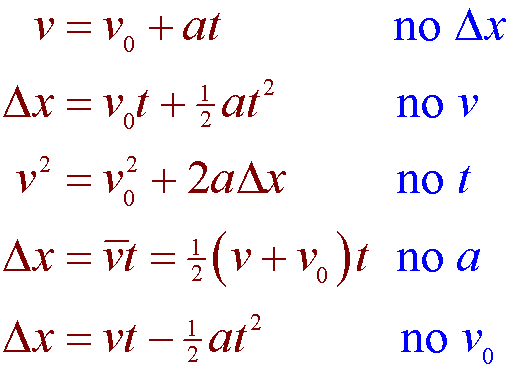
Calculate the fifth variable using kinematic equations.
. We still dont know what the constants of proportionality are for this problem. If values of three variables are known then the others can be calculated using the equations. S ut 12 at 2 and v 2 u 2 2as and these can be derived with the help of velocity time graphs using definition acceleration.
Some text books will give more than three kinematic equationsfor example they may provide range equations or different versions of the. Here acceleration is rate of change of velocity thus it is given by slope of v-t graph we use this to derive the first equation of motion while area under v-t graph gives total displacement and this is used to. For ease you can also use our online acceleration calculator for the calculations of the acceleration of the moving object from the different calculation formulas.
Enhancements have been made to most areas of the NIST REFPROP program including the equations of state for many of the pure fluids and mixtures the transport equations the graphical interface the Excel spreadsheet the Fortran files ie core property routines the sample programs in Python C MATLAB VB etc. The kinematic equation we will use is x x 0 v 0 t. The t in the kinematic equations refers to the time interval between the two points in the equation with y 0 occurring at the earlier time.
Till now we were looking at the Translational or linear kinematics equation which deals with the motion of a linearly moving body. We know the values of initial displacement 200 meters initial velocity 20 ms and time in motion 6 seconds. Start with the definition of average velocity.
After rearranging and simplifying the equations to solve for projectile motion they are given as. Some of the more important improvements. Also the variables of the kinematic equations are referring to the same direction.
Since we know the values of all variables but one we may plug in our known values to find the unknown value of x. I use Δt rather than t to be explicit that this is a time interval t t 0 and not a point in time. Horizontal x vertical y.
We must find final displacement. Each equation contains four variables. Three Equations of Motion are v u at.
Galileo tried to use his tidal theory to prove the movement of the Earth around the Sun. V x v 0 cosα v y v 0 sinα t 2v y g x v x t. Here we use kinematic equations and modify with initial conditions to generate a toolbox of equations with which to solve a classic three-part projectile motion problem.
To know more visit BYJUS. We can hand calculate the trajectory of a projectile with the kinematic equations. This page describes how this can be done for situations involving free fall motion.
S s 0 v t a To continue we need to resort. Kinematic equations relate the variables of motion to one another. Thus there are now two methods available to solve problems involving the numerical relationships between displacement.
The Mediterranean Sea had two high tides and low tides though Galileo argued that this was a product of secondary effects and that his. In Lesson 6 the focus has been upon the use of four kinematic equations to describe the motion of objects and to predict the numerical values of one of the four motion parameters - displacement d velocity v acceleration a and time t. Galileo theorized that because of the Earths motion borders of the oceans like the Atlantic and Pacific would show one high tide and one low tide per day.
The variables include acceleration a time t displacement d final velocity vf and initial velocity vi. Few Manual Examples Where You Can Use the Kinematics Calculator. Proportionality statements are useful but not as general as equations.
Lets say you are given an object that needs to clear two posts of equal height separated by a specific distance. These equations are all we need to solve flight time and flight distance for a projectile that is launched from ground level an initial height of zero. Expand s to s s 0 and condense t to t.
V s s 0.

Kinematics Equation Physics Classroom Equations Physics
Use These Equations To Solve The Motion Problem Challenge Https Www Teacherspayteachers Com Product P Physics And Mathematics Learn Physics Physics Lessons

Kinematics Using Kinematic Equations Equations Chemistry Worksheets High School Chemistry



0 Comments